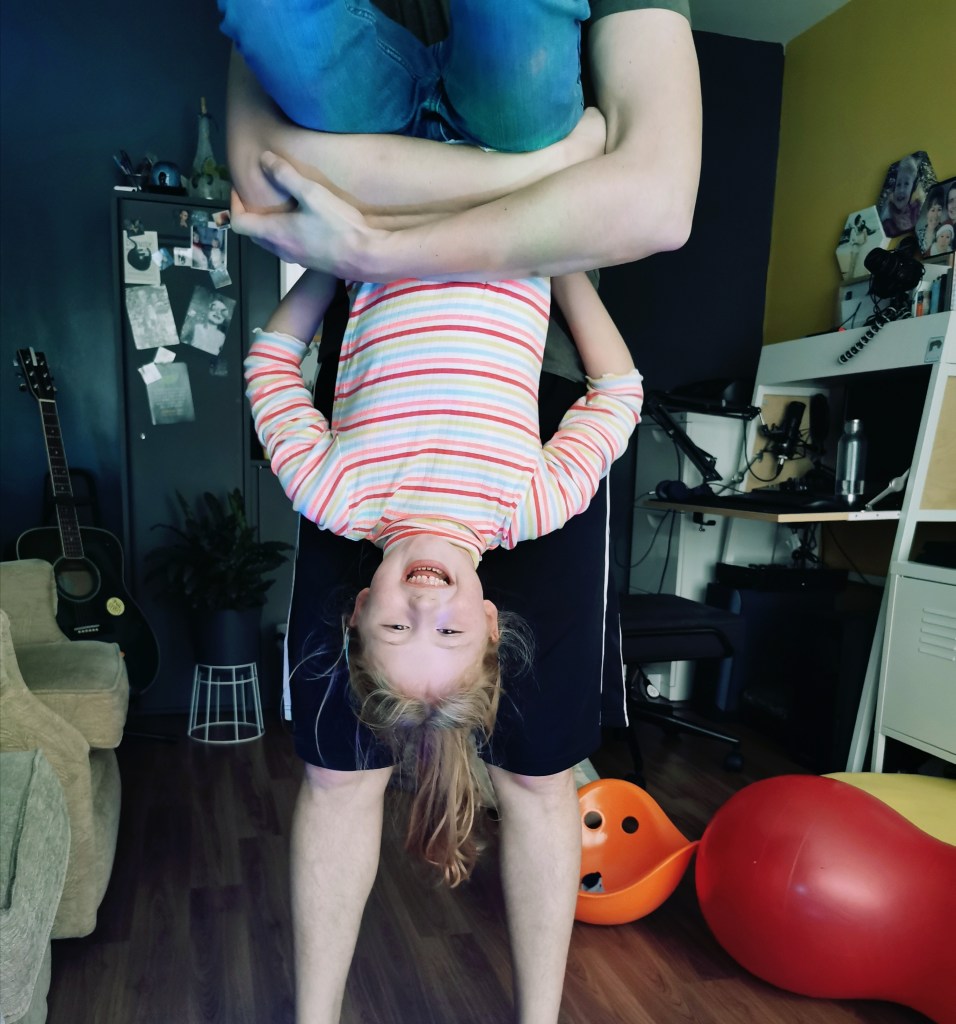
It’s incredibly hard to express just how strong the drive and compulsion that Trinity has to be upside down, in all kinds of shapes, and in multiple ways!
All we know is that if we don’t help facilitate her desperate need to be upside down, she gets so distressed and her anxiety levels go from zero to ten within a few minutes!
Trinity’s drive to be upside down can leave us incredibly fatigued, all you want to do is stop the activity, but Trinity has other ideas!
Interestingly, these behaviours reminded me of when I was young! My Mum was baffled as to how, or why I would regularly choose to hang upside down off the back of the sofa!
‘Isn’t this the best way to watch TV,’ my young self thought?
So what drives myself and Trinity to feel the need to be upside down?
Trinity and I are both sensory seekers, but what does this really mean?
We experience the environment in many different ways, other children, young people or adults with Autism may experience their environment in a similar way to Trinity and I, to be clear people with Autism may have some commonalities of behaviour and at the same time be different in many ways!
So in order to better understand sensory seeking behaviours (there are also avoidant behaviours) I will give a brief outline of sensory integration and sensory processing.
Sensory integration is that part of our brain which is involved in processing and organising sensations between our body and the immediate environment, when this part of our brain is functioning as it should, it helps us to use our bodies and adapt our responses appropriately within the environment around us.
To do this the brain is constantly registering, selecting, interpreting and comparing sensory information in a flexible and changeable pattern.
Let me briefly summarise Sensory processing here:
It is the process of our brain involved in receiving, interpreting and organising input from all of our senses at any given time!
The problem is when during everyday activities our ability to organise sensory input remains unorganised, it could be that the processing in our central nervous system is flawed or, incorrect. This means that a planned and appropriate response (behaviour) relating to that stimuli is not possible.(7 Senses Street Day, bringing the common sense back to our neighbourhoods, 2013, online: http://www.7senses.org.au)
One basic example I could give you (trust me there are many!) is when I go to open a door I often overestimate the amount of force required in order to open it, push it so hard that I nearly put a hole in the wall!
So going back to Trinity’s need to be upside down, and my frequent need to watch TV upside down (as an adult I have found yoga is a more functionally appropriate activity) we must take a look at our bodies internal sense known as “proprioception”. This sense tells us where our limbs and body are in relation to one another.
Proprioceptive messages are sent from sensory receptors found in our muscles and joints. They tell us how we are moving, what our individual body parts are doing in relation to each other, and where our body parts are in space (around us).
The proprioceptive system kicks in whenever we push or pull something, hence my problem of using excessive force to open a door! It is also engaged when our joints are compressed or pulled apart.
This system helps us to understand whether to apply more or less force, to successfully complete a task.
Proprioceptive input seems to have a calming effect and helps us to organise our body. This input is particularly helpful at times when we feel overstimulated or generally overwhelmed.
This type of input also aids our ability to balance, or modulate/regulate, the external sensory input coming at us from our other sensory systems.
It is for this reason that the proprioceptive sense acts as a sort of protector. So it is a really good idea to offer your child, young person or adult with various opportunities to enjoy ‘heavy work’ activities. These activities help Autistic people to better regulate their sensory experiences. (Heavy work Activities for Children, The Caldwell Autism Foundation Ltd)
I remember when I was little asking to play wheelbarrow over and over again, perhaps this was my was of managing the sensory input and calming my senses?
I know for Trinity that doing headstands and reverse crunches with myself and Daddy (mostly Daddy) usually helps to calm her and sometimes can even help to avoid her going into sensory overload and a subsequent meltdown!
Trinity absolutely loves wrestle/physical play, hanging upside down, jumping on a trampoline, squeezing and squishing sand, rice and play dough. We often do these activities when Trinity is anxious, but in my experience it is far better to offer regular sensory input in order to reduce or minimise the effects of possible sensory overload.
Click on the link below to read information, written by Corinna Laurie, specialist occupational therapist consulting at the NAS Helen Allison School and director of Evolve Children’s Therapy Services Ltd:
 Embracing-Autism