“Mum you better not set that timer, or else!”

Trinity doesn’t understand or seem to see the need to stop and wait for anything. Why would she, after all it really is an abstract concept!
Unfortunately since the beginning of the Covid-19 pandemic, there has never been a more far reaching and crucial reason for Trinity to learn the annoying art of waiting!
Let’s face it we’ve all experienced the feeling of not wanting to wait for something or someone. As young children, we might remember feeling frustrated on what seemed like to us, the car journey that would never end, driving our parents crazy with the all too familiar phrase, “Are we there yet?”
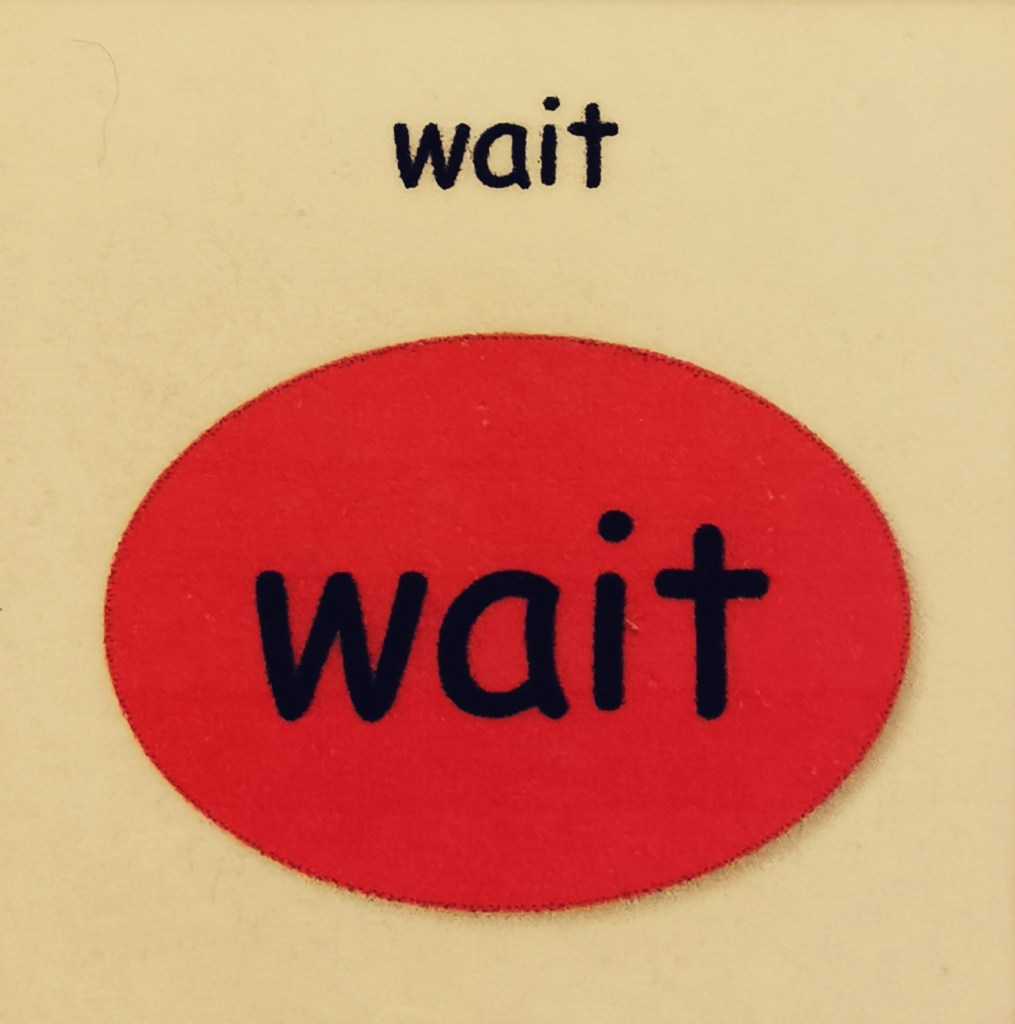
The above featured ‘wait’ symbol is from Pyramid Educational Consultants, creators of PECS, a symbolic pictorial form of communication. See the short video clip below explaining a bit about it and directing you to more resources available:
So what makes waiting so difficult for children/young people and adults with Autism?
It is the ability or reduced ability to be able to utilise our seemingly natural skills of ‘executive functioning.’ No I’m talking about people in business, at a function, eating canapés!
So what exactly is it and what does that have to do with waiting?
First of all I will give you a definition of executive functioning by Christopher Lynch PhD (2019) in his article from Pscychology Today:
“… neuropsychological process known as the ‘Executive Function‘ is heavily involved in making transitions. This function helps the brain to shift and reallocate attention and other brain resources when required. In autism, there are often gaps in this system. Because of these gaps, the brain may struggle with stopping one task and transferring attention and other thought processes onto another.” (Christopher Lynch PhD(2019), ‘Autism and Anxiety’ Online: https://psychology today.com [date accessed:30/1/21]
This is an issue I have struggled with my entire life. Frankly once I’m engaged in something, I may as well have a giant ‘Do not disturb’ sign above my head!
If my flow must interrupted, please wait, until I am paying attention because that means, either:
a) I’ve only just processed what you’ve said.
b) I may need you to repeat it again.
c) Having to change from what I was engrossed in to fulfilling another request has made me anxious, and I need a minute to adjust to the idea of it.
d) Going from what I’ve been intently focussed on and switching from that kind of processing, onto deciphering what anyone is requesting, or if they’re trying to engage me in a conversation, can quickly turn into a situation of information (processing etc.)overload.
When I’m in this overload state, trying to process too much, it’s as if I have moments of blank, when really my ears literally cut out, I temporarily loose my ability to hear.
This can be incredibly embarrassing for me especially in a work setting as I may well have heard the start of your sentence, perhaps even the last word of it, but everything else is missing!
When I was young I became very good at guessing what was asked of me by filling in the blanks with the small fragments of words I managed to process!
Today at 45 I have finally found the confidence not to do this, I will ask a colleague to repeat the question or comment again.
In all honesty it depends upon my levels of anxiety and how much noise is present in the environment at the time as to whether or not I find it incredibly difficult or am able to hear, process and transition from one task to another.
So what does all this look like for Trinity? If you rush her into changing a task or following an instruction she will very quickly become anxious and agitated.
If I have held her hand to encourage her to move away from the task, or place she wants to be, she will quickly let us know by pulling us back to the preferred place or task.
This can be frustrating at times particularly if I’m in the middle of cooking dinner and I have to wait for Trinity to be ready(meanwhile the curry downstairs is sticking to the pan).
Cultivating great patience is an absolutely essential part of your personality when bringing up a child with Autism and also in understanding adults with Autism.
I often notice with Trinity, if I turn her attention from her chosen activity, It is really important to give her time to process and accept leaving the activity!
I will then need to wait until she seems to have responded to my request. If she still doesn’t seem to have processed it all; or is not yet ready to respond to my request, I will then review the language I’ve used.
To do this we would simplify or cut out any connective words, only including important ‘information carrying’ words, after all those are the most important elements of communicating a want or need!
Once Trinity finally decides she’s ready to go with me, she often then gets frustrated if whatever I’m doing isn’t ready (dinner).
“This sounds like all young children I hear you say.”
You’re not wrong, however where there is a stark contrast in a child like Trinity who is Autistic, she will want the dinner to come out of the oven when it’s only just gone in!
She even sits in front of the oven watching the sausages or chicken (her favourite) cook, she then starts to try and open the oven door. So I say, “not ready” and I say and sign “wait” then she gets really annoyed!
I tell you, “Mum you better not set that timer, or else!” I can imagine her saying.
That is exactly what I do next! She then at this point either accepts it, or starts to go into meltdown mode!
Aside from cooking dinner difficulties, Trinity often gets anxious and upset when I say and sign “time to get dressed!”
Dressing undressing is a real issue at times!
Waiting at the door too, if her shoes and coat are on it’s time to go! I say, “Trinity Mummy put shoes on” (pause) “Then we go.”
At this point even though I am using less language, I supported her understanding and processing by using sign, sometimes it’s still not enough to help her to cope with waiting calmly.
Perhaps it is because she is already anxious and out of my attempt to reduce the language Trinity still only managed to hear the word ‘Go’, then naturally we would all get confused and annoyed if someone was telling us, “Green to Go”, when they suddenly change it back to, “Red to Stop!”
This is where I feel a visual aid like the PECS symbol for ‘wait,’ may help her to understand when waiting begins and ends and therefore reducing her levels of anxiety around how long this waiting might last.
I haven’t tried this yet with Trinity but I am going to begin very soon, because, her anxiety around waiting is getting more apparent, and having a negative impact on hers and our own mental health!
I have seen some amazing results, in the specialist Autism school that I once worked in, when using the ‘wait’ symbol. It was sometimes paired with a physical timer that the child could see.
To be honest her anxiety around waiting to go out has increased tenfold since this second lockdown, Trinity has regressed in some ways since Covid-19 and both Lockdowns!
Click the link below to a video by the ‘EARLY AUTISM PROJECT’, there you can find out more about teaching a ‘waiting’ programme! (There are also free printable resources)
If you want to learn more about issues of waiting etc. Click the link below to access an academic article, which gives a good understanding as to why waiting, might be difficult for anyone with an Autism Spectrum Disorder. (They are also researching the effectiveness of Tic Tac software as an intervention to help reduce anxiety during waiting or transition times)
On an incredibly positive note, it is this ability to intensely focus on a task or project (which often is characteristic of children, young people and adults on the spectrum) which lends itself to the most wonderfully diverse achievements, where the greatest attention to detail has been paid, at every turn!
Whether these details go unnoticed, or are obvious to the observer and celebrated, you can be sure that if you’re served hot buttered toast, it may well be that if it’s the most thoroughly and generously buttered toast you’ve ever had, then maybe, just maybe, someone just like Trinity has made it.
Or if you have ever read anything about the great engineering achievements of Dr. Temple Grandin, who is Autistic, but for a good part of her childhood was non-verbal. She is one tenacious, determined and highly focused individual. Well known for her outstanding ability to pay the most intense and specific attention to detail in her work.
It is a person with Autism’s ability to focus on seemingly insignificant details, alongside a surprising ability to see a problem, find a creative and often unusual solution, that makes them so great to be on your team! Whether at school, home or the workplace they will be a great asset. Surely, this should and must be seen as a great ability and therefore be highlighted and celebrated!
We will continue to seek ways to help Trinity to overcome the things that she struggles with, waiting, and the intense anxiety she experiences, when processing during tasks and transitions.
More importantly we will always try our best to look at her unique abilities and the characteristics that make her the clever little problem solver that she is!
Trinity when it comes to solving a problem it’s definitely ‘Green to Go!’
 Embracing-Autism
So well written and helpful
LikeLike
Thank you 💖
LikeLike