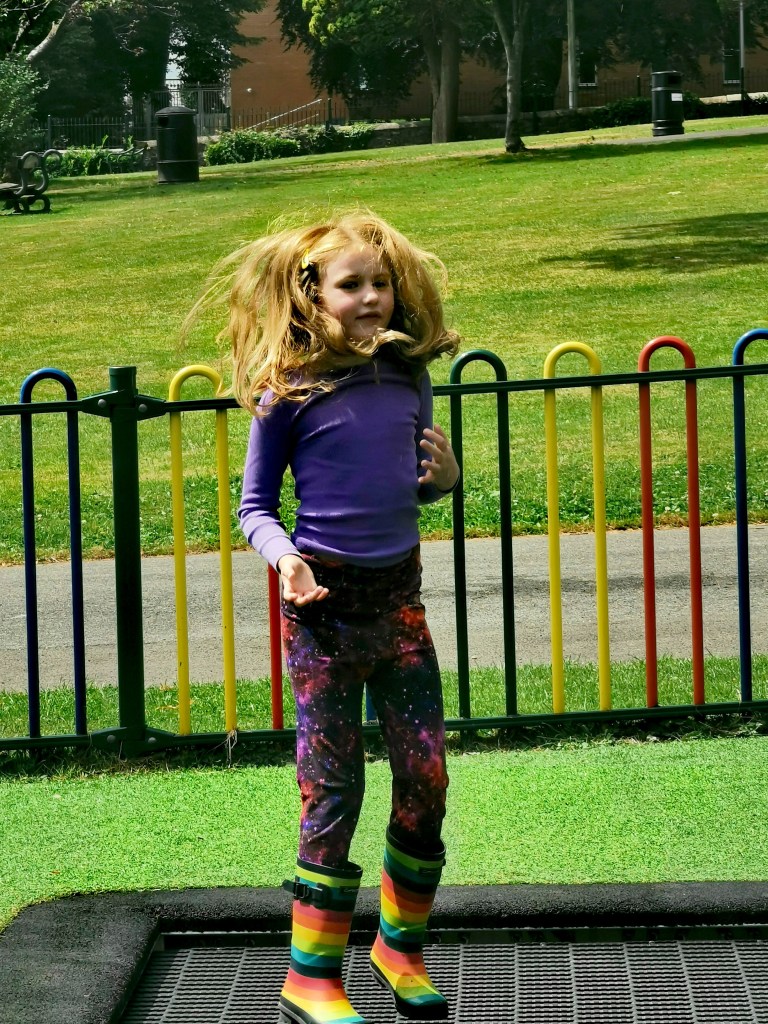
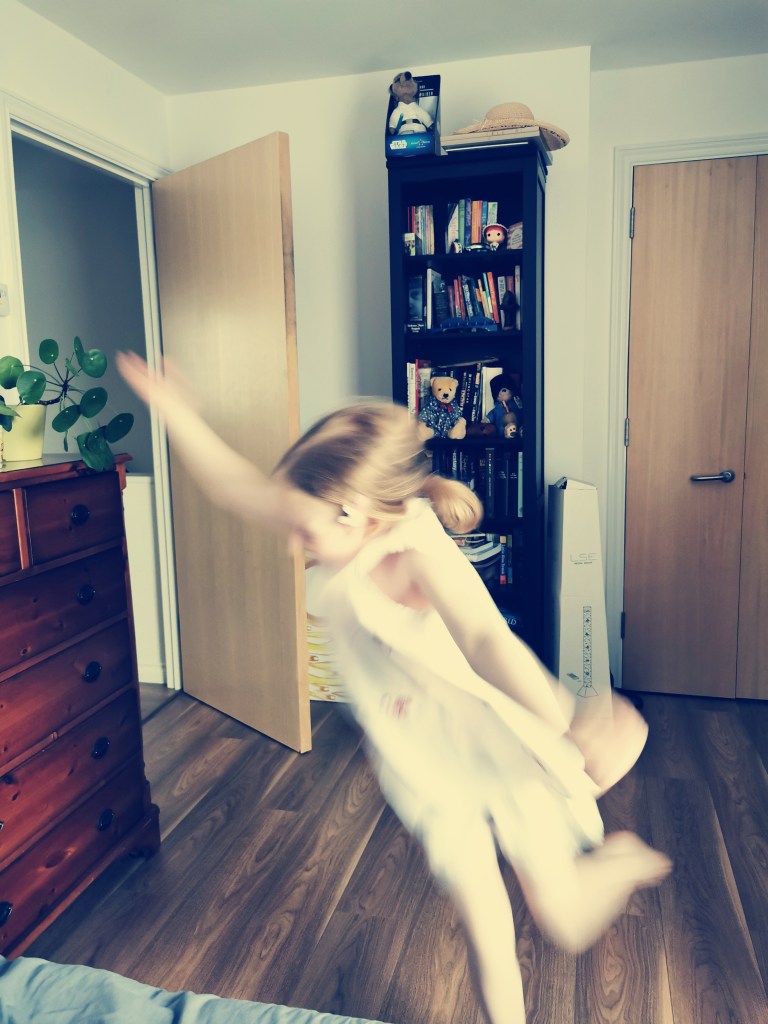
“Watching the sheer delight on Trinity’s face when she is jumping and clapping is wonderful and fascinating to see! “
In this article I will talk a bit about what stimming is and the highs and lows of stimming.
According to Smith, L (2018) Stimming is defined as:
‘Repetitive body movements or repetitive movement of objects is referred to as self-stimulatory behavior, abbreviated to stimming. Stimming can occur in autistic people and those with other developmental disabilities.’ (Smith, L 2018 ‘What is Stimming?’ Online: [https://www.medicalnewstoday.com/articles/319714] Date Accessed: 25/9/2021)
So let’s break it down a bit here because it is a lot more complex than just some random movements!
There are five types of stimming:
1. AUDITORY:
• Vocal sounds such as humming, grunting and high-pitched squealing.
• Tapping objects, covering/uncovering ears, finger snapping and clapping.
• Repetitive Speech, quite often lines from a movie, short phrases or whole sentences of a favourite book and song lyrics.
2. TACTILE:
• Skin-rubbing/scratching, with hands or objects!
• Hand movements, opening and closing fists.
• Finger-tapping
3. VISUAL:
• Staring/gazing at objects, ceiling fans or lights.
• Repetitive blinking or turning lights on/off.
• Moving fingers in front of eyes
• Hand flapping
• Eye tracking/peering from the corner of the eyes
• Object placement, in a very carefully constructed specific way, lining objects up etc.
4. VESTIBULAR:
• Rocking front to back and side to side
• Spinning
• Jumping
• Pacing
5. OLFACTORY (smell/taste)
• Sniffing/smelling people and /or objects
• Licking
• Tasting objects by placing them into the mouth
I can quite categorically say that throughout any given day that Trinity would have gone through most, if not all the five types of stimming! Trinity is a super sensory seeking child and when she is free to stim and gains appropriate sensory integration throughout her day she is a much calmer little girl and better able to access her small group activities in school and her ability to communicate increases.
Stimming is important to Trinity and to me! It helps to keep us calm and better focused, can give us a sense of well being or relief. It is comforting and reduces anxiety for multiple reasons but it also, very importantly gives us:
EXTREME JOY!

So we’ve talked about the highs of stimming, but what about the lows? Stimming can be seen as negative either by others or for the individual because it could possibly become unsafe, or even harmful for the person.
It could be that it is seen as socially inappropriate and then it could possibly lead to exclusion from their peers or in my case work colleagues.
Sometimes what starts off as a stim might become a type of physical harm however I will say that in my own personal experience of this, me being a serial skin scratcher, it is usually a case of me not realising that I’ve scratched either too hard, or two many times and that I’ve accidentally broken the skin!
To me it just feels like a really huge relief to scratch that itch, until I stop and suddenly realise that I’ve unintentionally hurt myself!
However in my opinion stimming should not be placed into the same pot as self-injurous behaviours(banging limbs, head and objects etc) but for some it is a grey area!
I feel it is better to remind someone that they are scratching a lot and might become sore but it is also very important to not stop Autistic people from stimming, it is a very important coping mechanism for us and in my opinion controlling stimming too much can run the risk of triggering negative behaviour’s towards themselves and even perhaps those around them.
Other potentially negative stims are those that may be classed as emotionally harmful, such as repetitive internalised negative self-talk!
Lastly a person who is verbally stimming could be misunderstood depending upon what kind of verbal behaviour they are displaying, for example the way that they seek out and initialise communication can be very confusing and may lead to the communicative partner feeling like they might head butt them, when in actual fact they are just saying hello!
I can recall now one way that I could be misunderstood by a colleague that I can’t help but sign naughty to almost every time I see her in passing, I think she understands why I’m doing it and we laugh about it often! It definitely brightens up what can often be a very stressful and challenging working environment. Most recently I even discovered the incredible power of the lollipop in calming me down! Lollipops are all powerful!!! (Willie Wonka understands me)
Trinity and I have a, ‘need to stim,’ understanding and sometimes she giggles like mad when I stim! We understand the compelling need is overwhelming at times and can lead to sensory overload if we don’t get it out of our systems!
It’s important to respect the needs and the rights of an Autistic person and that most definitely includes the right to stim, no-one should ever make anyone feel bad for stimming and preserving their dignity is very important. That being said it is important to note that given the right sensory profile, Integration & diet it is possible that the need to stim will be less frequent!
But oh it is such fun!!!
 Embracing-Autism